Premium Quality with Lifetime Warranty

Summer Kickoff
15%OFF Sitewide
Use code: SUMMER26

Modular Monitor Mounts (25 products)

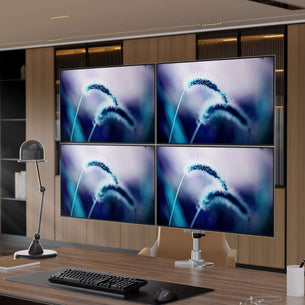
Premium modular monitor mounts for specific requirements. Select your base model and choose from multiple components for an exact customization. Mount-It! Modular Mounts are cost effective and can be upgraded over time, giving you a variety of choices for your growing workspace.

Why choose a Mount-It! Modular Mount?

  • Premium products made from cast aluminum
  • Fully customizable for all your monitor mounting needs
  • Expand your workspace as you see fit
  • Multiple component integration
  • Sleek design for just the right look
  • TAA Compliant – Ideal for Government purchases
Modular Monitor Mounts - Mount-It!
  • Outline of two open hands positioned upward supporting a shield with a checkmark inside, representing protection, security, or assurance in a simple, minimalistic style with solid blue lines on a transparent background.

    Premium Quality

    All of our products pass through stringent testing development.

  • A black outline of a thumbs-up icon is surrounded by the words “LIFETIME GUARANTEE” in bold blue letters, forming a semicircle above and below the icon.

    Lifetime Warranty

    Warranty covers any defects in material or workmanship under normal use.

  • Blue outline icon of a delivery truck with a large gift box on its back. The word FREE is written on the box, and a bow is on top, indicating free delivery or shipping.

    Free Shipping

    Free ground shipping on all orders within the contiguous United States.

  • Simple blue line drawing of a dollar bill with a curved arrow circling around it, representing money being refunded, returned, or exchanged.

    60-Day Free Returns

    Free returns for a full refund. We cover shipping costs for orders from the contiguous US.

  • An outline of the United States map with the letters USA written in bold, uppercase font in the center. The design is simple with a blue border and no additional details.

    US Based Brand

    American owned and operated. Designed and supported in San Diego.

Modular Monitor Mounts

View as

Frequently Asked Questions

Will this monitor arm support my monitor's weight?

A monitor arm has a published weight capacity range, typically expressed as a minimum and a maximum (for example, 4.4 to 19.8 lbs per arm). Your monitor's weight must fall inside that range, not just under the maximum.

Why minimum weight matters: Most premium monitor arms use gas-spring or mechanical-spring tension to hold the monitor at any height. The spring is calibrated to a weight range. If your monitor is lighter than the minimum, the arm will drift upward; if heavier than the maximum, the arm will drift downward or sag.

How to check your monitor's weight:

  • The monitor manufacturer's spec sheet lists the weight with stand and without stand. The arm needs to support the weight without stand.
  • For an estimate: most 24 inch monitors weigh 8 to 15 lbs without stand; 27 inch monitors typically weigh 12 to 20 lbs; 32 inch monitors weigh 15 to 30 lbs; ultrawide and 4K models can weigh more.

Other fit checks:

  • VESA pattern: the monitor must have a 75x75 mm or 100x100 mm VESA pattern. If not, a VESA adapter kit is required.
  • Total arm load if dual-arm: a dual monitor arm has a weight rating per arm.
  • Mount type fit: clamp mounts need desk edges of compatible thickness; grommet mounts need a hole through the desk surface.

Mount-It! monitor arms publish per-arm weight capacity, supported VESA patterns, and clamp/grommet compatibility on every product page.

What monitor mount works for two monitors of different sizes?

Two monitors of different sizes can be mounted on a dual monitor arm or on two independent single arms, as long as the arms support each monitor's individual weight, VESA pattern, and screen size.

What to look for:

  • Independent height adjustment per arm. Each arm needs to move up and down independently to align both screens to your eyes.
  • Independent tilt and swivel per arm. Different sizes mean different bezel heights and viewing angles.
  • Per-arm weight capacity that fits the heavier of the two monitors.
  • VESA compatibility for both monitors. Monitor VESA patterns are typically 75x75 mm or 100x100 mm.
  • Total span and arm reach. Independent arms with enough horizontal reach let each screen be positioned correctly.

Dual monitor arm vs two single arms:

  • A dual arm has both monitors on a single base/clamp, cleaner desk look, fewer clamps to manage.
  • Two single arms give maximum independent positioning, including different desk locations or asymmetric layouts.

Mount-It! offers single, dual, and modular monitor arms with per-arm weight capacities, VESA support, and clamp/grommet options.

What monitor arm should I look for with an ultrawide monitor?

Ultrawide monitors (typically 29 inch, 34 inch, 38 inch, or 49 inch with 21:9 or 32:9 aspect ratio) are heavier and wider than standard monitors. The arm needs to be rated for the weight, support the right VESA pattern, and offer enough reach.

Weight capacity: Ultrawide monitors typically weigh 15 to 30+ lbs without the stand. Some 38 inch and 49 inch ultrawides exceed 30 lbs. Choose an arm rated comfortably above that figure (20%+ headroom).

VESA pattern: Most ultrawide monitors use a VESA pattern of 100x100 mm. Larger ones may use 200x100 mm or 200x200 mm.

Key arm features for ultrawide use:

  • Heavy-duty rating with high per-arm capacity (30 lbs or more is preferred for 34 inch+ ultrawides).
  • Single-arm preferred over dual. Ultrawides take up the desk width that two standard monitors would occupy.
  • Long horizontal reach so the screen center reaches your eye line.
  • Reinforced pivot points. The wider screen creates more torque on the pivot when tilted or swiveled.
  • Cable management. A clean cable channel along the arm prevents tangle.

Mount-It! offers heavy-duty single and dual monitor arms rated for ultrawide displays, with per-arm weight capacity, supported VESA range, and reach distance published per product.

What should I look for in a dual monitor mount for a desk?

A dual monitor mount holds two monitors side by side on a single desk attachment, freeing up desk surface and giving each screen independent height, tilt, and swivel adjustment.

Weight capacity per arm: The rating is published per arm, not total. For two 24 inch monitors at 10 to 12 lbs each, an arm rated 17.6 lbs per arm is sufficient. For 27 inch monitors at 15 to 20 lbs, look for 19.8 lbs or higher per arm. For 32 inch or ultrawide monitors, choose a heavy-duty rating of 30+ lbs per arm.

VESA support: Most monitors use 75x75 mm or 100x100 mm. Confirm the arm supports the patterns of both your monitors.

Independent arm adjustment: Each arm should move up, down, tilt, swivel, and rotate independently of the other.

  • Crossbar style: cleaner look, simpler structure, but less independent positioning.
  • Independent arm style: each monitor has its own articulating arm sharing the same desk base. More flexible positioning.

Desk attachment options: clamp clips onto the back edge of the desk; grommet bolts through a hole in the desk for more secure attachment.

Mount-It! offers dual monitor arms, dual monitor wall mounts, and modular monitor mount systems with per-arm weight capacity, supported VESA range, clamp/grommet options, and reach distance published on every product page.

Any tips for aligning multiple TVs or monitors on a wall (like a video wall or side-by-side screens)?

Whether it's for a multi-screen gaming setup or a video wall effect:
Measure and level carefully: Mark out the positions with pencil and a laser level if available. Small errors will be very noticeable when screens are adjacent.
Use the same mounts: Ideally use identical mounts for each TV/monitor so that their depth from the wall and adjustment range are the same.
Spacing: Decide the gap you want between screens. Use spacers or a template to ensure equal spacing.
One by one: Mount and fully install one TV first, then use it as reference for the next. Measure from the first TV's position to place the next mount points.
Adjustability: If the mounts have any post-install adjustment, that helps. Some video wall mounts allow micro-adjustments.
Check from viewing angle: Once up, view the multi-screen setup from your normal spot.
Multi-monitor mounts: If these are smaller monitors, consider a multi-monitor mount system (some handle 2-4 monitors on one frame). For large TVs, those are usually separate mounts.
Patience and precision are key. Measure twice (thrice!) and drill once.